Check the fastest century in ODI history with full updated list, records, players, and stats. See who scored the quickest 100 in ODI cricket.
There are moments in cricket that feel scripted. The crowd rises. The bowler walks back in disbelief. The scoreboard struggles to keep up. And somewhere in the chaos of cheers and flashing cameras, history is being written.
One such moment belongs to the Fastest Century in ODI History — a record that represents not just numbers, but audacity, timing, power, and pure cricketing genius.
Scoring a century in One Day Internationals (ODIs) is already a monumental achievement. You battle 50 overs of pressure, strategy, and relentless bowling. But to score 100 runs in barely half an hour? That is something extraordinary. That is a statement. That is legacy.
In this detailed guide, we explore the Fastest Century in ODI History, the players who came close, the stories behind those unforgettable innings, and why this record continues to captivate cricket fans worldwide.
What Makes an ODI Century So Special?
ODI cricket sits beautifully between Test cricket’s patience and T20’s explosive urgency. A century in this format requires balance — you cannot simply swing blindly. You must build an innings, rotate strike, assess conditions, and then accelerate.
That’s why the Fastest Century in ODI History holds a different kind of magic. It challenges the very rhythm of the format. It turns a calculated game into a spectacle. It transforms pressure into dominance.
When a batsman races to 100 in record time, bowlers panic. Captains rethink strategies. Field placements shift constantly. Momentum swings violently.
And the fans? They witness something unforgettable.
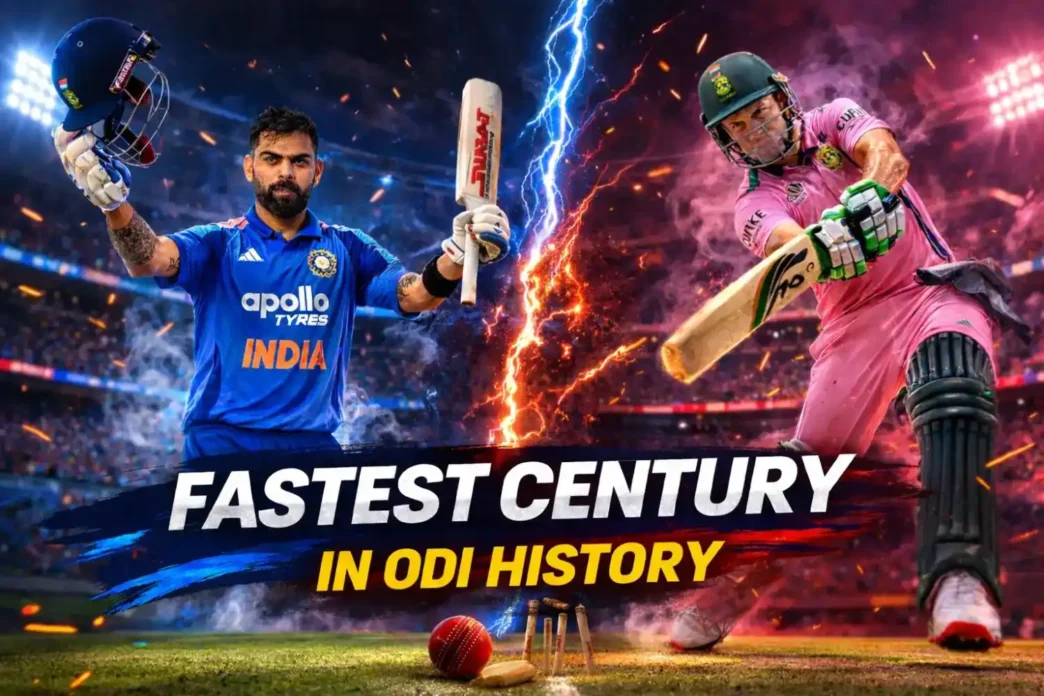
The Record Holder: AB de Villiers (South Africa)

Fastest Century in ODI History
- Player: AB de Villiers
- Country: South Africa
- Balls Taken: 31
- Opponent: West Indies
- Venue: Johannesburg
- Date: 18 January 2015
- Final Score: 149 runs off 44 balls
On a summer evening in Johannesburg, AB de Villiers did something that seemed impossible. He reached his century in just 31 balls — rewriting cricket history in real time.
He didn’t just hit boundaries. He dismantled the bowling attack.
South Africa were already in a strong position when de Villiers walked in. But what followed was beyond expectation. Sixes rained down. Sweeps, reverse sweeps, inside-out drives — he used every angle of the field. It was artistry mixed with aggression.
By the time he reached 100, even the opposition players applauded. Commentators ran out of adjectives.
That innings still defines the Fastest Century in ODI History, and more than a decade later, the record remains untouched.
The Top 10 Fastest ODI Centuries (Updated 2026)
Here are the fastest centuries in ODI cricket history:
- AB de Villiers (South Africa) – 31 balls vs West Indies (2015)
- Corey Anderson (New Zealand) – 36 balls vs West Indies (2014)
- Shahid Afridi (Pakistan) – 37 balls vs Sri Lanka (1996)
- Mark Boucher (South Africa) – 44 balls vs Zimbabwe (2006)
- Brian Lara (West Indies) – 45 balls vs Bangladesh (1999)
- Shahid Afridi (Pakistan) – 45 balls vs India (2005)
- Jesse Ryder (New Zealand) – 46 balls vs West Indies (2014)
- Jos Buttler (England) – 46 balls vs Pakistan (2015)
- Sanath Jayasuriya (Sri Lanka) – 48 balls vs Pakistan (1996)
- Kevin O’Brien (Ireland) – 50 balls vs England (2011 World Cup)
Each of these innings had its own context, emotion, and impact.
Corey Anderson – New Zealand’s Power Storm

Before AB de Villiers shattered expectations, Corey Anderson held the record.
On New Year’s Day 2014, playing for New Zealand against West Indies in Queenstown, Anderson reached his century in just 36 balls.
It was brutal hitting. Clean. Relentless. Fearless.
At that time, it felt unbeatable. Cricket analysts predicted the record might stand for decades. But cricket, as always, had surprises in store.
And just one year later, the Fastest Century in ODI History changed hands dramatically.
Shahid Afridi – The Original Game Changer
In 1996, when aggressive ODI batting wasn’t common, Shahid Afridi stunned the cricketing world.
Playing for Pakistan against Sri Lanka in Nairobi, Afridi smashed a century in 37 balls using a borrowed bat from Waqar Younis.
Let that sink in.
A teenage cricketer walks in and destroys an international bowling attack with fearless hitting. That innings was ahead of its time. Afridi didn’t just score fast — he changed how people saw ODI batting.
While he no longer holds the record for the Fastest Century in ODI History, his impact on the evolution of attacking cricket is undeniable.
Kevin O’Brien – A World Cup Miracle
One of the most emotional entries on this list belongs to Kevin O’Brien of Ireland.
During the 2011 ICC Cricket World Cup, Ireland were chasing a massive total against England. At 111 for 5, hope seemed lost.
Then O’Brien unleashed one of the greatest counterattacks in World Cup history. He reached his century in just 50 balls — at the time, the fastest in World Cup history.
Ireland went on to win that match in a stunning upset.
This is why the Fastest Century in ODI History isn’t just about numbers. It’s about context. Pressure. Drama.
Why This Record Is So Hard to Break
Scoring 100 in 31 balls requires:
- Exceptional hand-eye coordination
- Impeccable timing
- Mental clarity
- Fearless intent
- Favorable match conditions
Even in the modern era of power-hitting, bowlers are smarter. Data analytics guide field placements. Fitness levels are higher.
Yes, ODI cricket has become more aggressive thanks to T20 influence. But breaking the Fastest Century in ODI History still demands something extraordinary.
It demands a perfect storm.
Has Modern Cricket Come Close?
In recent years, explosive players like:
- Glenn Maxwell (Australia)
- Jos Buttler (England)
- Rohit Sharma (India)
- Fakhar Zaman (Pakistan)
have played breathtaking innings.
But none have breached the 31-ball barrier.
Many have crossed 50 in under 20 balls. Several have reached 80 at lightning pace. But converting that into a 100 within 30 balls remains cricket’s ultimate speed challenge.
Impact on Team Strategy
A record-breaking fast century completely alters a match.
- Bowlers lose confidence.
- Captains run out of defensive options.
- Fielding sides feel psychological pressure.
- The batting team gains unstoppable momentum.
In fact, the innings that set the Fastest Century in ODI History helped South Africa post a monumental total of 439 runs against West Indies.
That kind of dominance shifts tournament narratives.
Technology, Bats & Evolution
Today’s bats are lighter, stronger, and engineered for power. Training methods have evolved. Players practice innovative shots — ramps, scoops, reverse sweeps — regularly.
The rise of franchise T20 leagues has also improved finishing skills.
All these factors suggest that one day, the Fastest Century in ODI History might be broken.
But until someone crosses that 31-ball milestone, AB de Villiers remains the undisputed king.
Emotional Side of a Fast Century

Statistics tell one story. Emotion tells another.
Imagine being in the stadium. Every ball flies to the boundary. The crowd doesn’t sit down. Commentators scream. Social media explodes.
In 2015, clips of de Villiers’ century went viral globally. Within hours, it was trending everywhere.
That is the power of the Fastest Century in ODI History — it transcends cricket fans and captures casual viewers too.
Can the Record Be Broken in the Future?
Cricket is evolving faster than ever.
Young players grow up watching fearless batting. Strike rates once considered reckless are now normal.
It is possible that someday a batter will score a century in 30 balls — or even less.
But when that day comes, comparisons will always return to Johannesburg 2015.
Because the first time something magical happens, it carries a different weight.
Final Thoughts
Records in cricket come and go. But some become timeless.
The Fastest Century in ODI History is more than a statistical achievement. It represents courage. Innovation. Dominance.
From Shahid Afridi’s teenage explosion in 1996 to Corey Anderson’s New Year storm, and finally to AB de Villiers’ unforgettable 31-ball masterpiece — this record tells the story of how ODI cricket transformed.
It reminds us why we love the game.
Because in cricket, one innings can redefine possibility.
And somewhere in the future, under bright stadium lights, another player may attempt to rewrite history again.
Until then, the benchmark remains clear.
31 balls.
AB de Villiers.
South Africa.
A moment that still echoes across cricket grounds worldwide.
Frequently Asked Questions (FAQs)
1. Who holds the record for the Fastest Century in ODI History?
AB de Villiers of South Africa holds the record for the Fastest Century in ODI History, scoring 100 runs in just 31 balls against West Indies in 2015.
2. How many balls were taken to set the Fastest Century in ODI History?
The Fastest Century in ODI History was achieved in only 31 deliveries, making it the quickest hundred ever recorded in One Day International cricket.
3. Which players came close to the Fastest Century in ODI History record?
Corey Anderson (36 balls) and Shahid Afridi (37 balls) came very close to the Fastest Century in ODI History, but neither could surpass the 31-ball milestone.
4. Was the Fastest Century in ODI History scored in a World Cup match?
No, the Fastest Century in ODI History was not scored during a World Cup. However, Kevin O’Brien holds the record for the fastest World Cup century, reaching 100 in 50 balls in 2011.
5. Can the Fastest Century in ODI History record be broken in the future?
With modern aggressive batting and T20 influence, many believe the Fastest Century in ODI History record could eventually be broken, but it would require an extraordinary and near-perfect innings.